Has anybody ever taken you to one side and brought to your attention certain mannerisms which they find irritating. Now as readers will be aware like all project managers, I have no faults, am perfect in every way, suffer from a surfeit of modesty and could not possibly have irritating mannerisms.
Seriously though I am well aware of my shortcomings, but mannerisms? You may ask what is this defect? Is it some sort of anti social behavior? Do I invade people’s space or suffer from severe halitosis? No, I tend to perch my spectacles on the end of my nose and look at people over the top of them. I did not realize I was doing this until it was pointed out to me. The reason I do it is I need the specs to read only, so if I want to concentrate on someone ie see them I peer over the top.
I have been told that this disconcerts staff, makes consultants nervous and is a precursor to refusing subcontractor variations. Therefore, some may say it is a good mannerism, but in the cozy political correct business world of today we cannot have conflict within the “stakeholders” as we are all on the same page etc etc.
What absolute nonsense. My job is to safeguard my employer’s wallet and if those who want to get into that wallet are irritated by my mannerisms – tough.
I don’t do it on purpose, for affect or with malice aforethought, so if anybody else has noticed any other irritating mannerisms please let me know.
All the successful project managers I have known have had a common thread. They have certain traits that distinguish them from other PMs or other members of the project team.
I decided to hit the keyboard on the subject as I have been talking with perspective employers about the next project. Invariably the question they all ask is what are your strengths? (easy peasy) but you know what is next – what are your weaknesses?
Now I have hire many staff over the years from Project Directors on $2billion projects to site clerks, and I have asked the same questions. The hard part is divorcing the kind of person you want as the employer and deciding on the right person for the project. I have hired people who could be the most difficult, recalcitrant and plain bloody minded but they were right for the job. I have also hired people that I thought at interview were marvelous people, and they were, but you would not put them in charge of a free bar.
Now when I am asked about my strengths I admit that I trot out the normal stuff. I will use one word for each: team, relationships, example, foresight, leadership, tenacious, focussed, driven, professional, experience etc etc. I usually add a few others that satisfied clients have used about some completed projects: the shark, hit-the-ground-running, and my favorite which I was described as by a very influential Arab developer – Mr Wolf
So how to respond to the “Weakness” question. You need to be honest. I have had people become more humble than Uriah Heap and advise them to try social work not project management. I have had some who have no weaknesses (next candidate please). The secret is be prepared for the question as it always gets asked.
But returning to the common thread and PM’s traits there is one weakness that does surface in many of us. That is we take over a team member’s critical tasks sometimes if that person is struggling. Yes as good leaders we know that people make mistakes and we council, train, “mother hen” them. We don’t let them go under. But the response during the interview is usually on the lines:
“some people may see it as a weakness but when a team member is struggling with a critical task I go out of my way to help them achieve the goal they are striving for”
No I have not “seen the light”, done a Saint Paul, or had some other recent mystical experience.
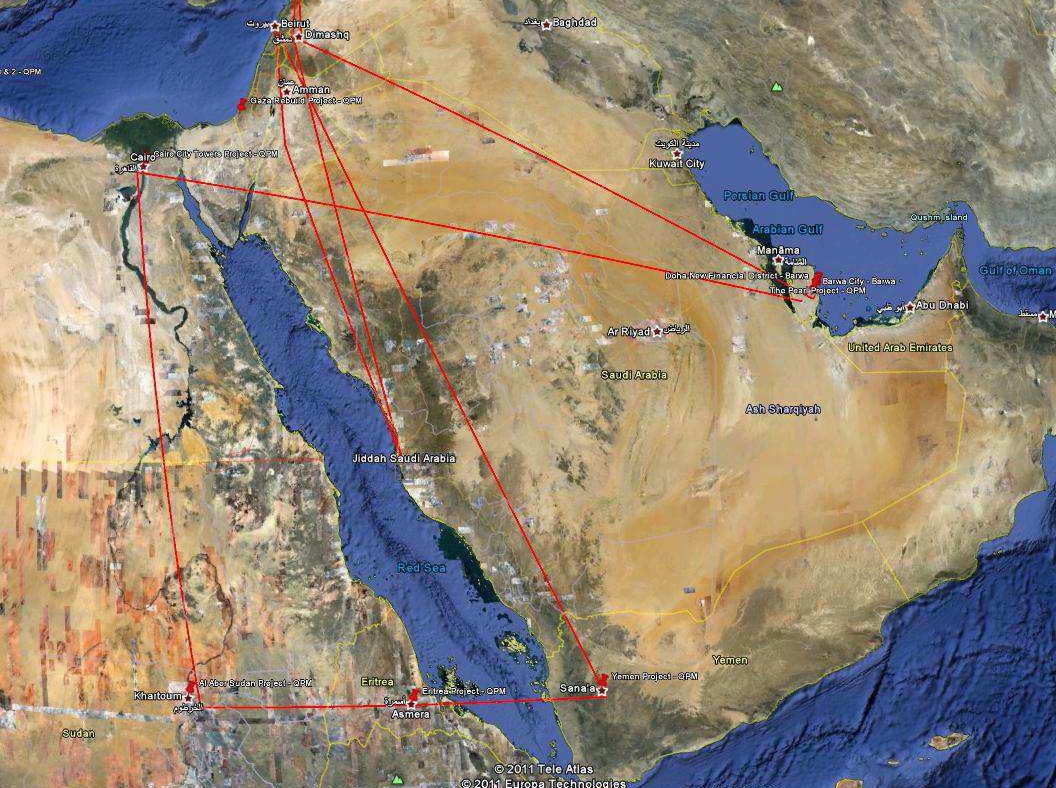
This post is about my business trip from Latakia in northern Syria by road along the M5 to Damascus and then on to the M1 to Beirut.
The plan was simple fly from my office in Doha Qatar to Latakia Syria (on the Mediterranean just south of the border with Turkey. Doha to Latakia is about 2,000 klms ie Brisbane to Ayres Rock or say London to Sicily. But of course in the Arab world things are never that simple. There are visas, questions about what country’s passport you hold, the reason for the visit etc. The Middle East is not the same as traveling through the EEC even for me with dual nationality of Australia and UK so two passports.
It was decided the day before the trip that we would pop over to Sannaa (Yemen) and Kartoum (Sudan) as we had construction projects in these locations too. Now I have been to damascus before and Beirut but not on the same trip , Yemen and Sudan were my first visits. I was not concerned as we were usually bumped up from business to first class on the plane, drivers waiting at the airport to take us to the best hotel in town. Anyway that afternoon my very efficient PA and Sami brought in my travel documents and local currency for each country. I should point out that Sami does not have a job title, he is a local and he only can be described as “a fixer”. You need a visa, driving licence, tickets for anythink, the Sami will speak to one of his “cousins” who all seem to work at a minisitry of something in the government, and things just happen.
The big surprise for me was amongst the documents there was a form I had to sign – my kidnap insurance, and the port were my body was to be sent to. The reason for this was we were off to Sudan and Yemen. But Sami assured me there should not be a problem as were ere not Americans, my colleague was British. So with lots of enshallas and mafi mushkalas the paperwork was completed and we were off the following morning.
At Doha airport the flight plan had changed it was now Doha to Damascus and then a four hour drive from Damascus up to Latakia, an overnight stay then a four hour drive back to Damascus the f0llowing morning. So we arrived at Damascus and our driver failed to show. So we just hired a car and set off on the M5 which sounds impressive but is not. It is a single lane highway but wide enough for three lanes in either direction. In other words it is a motorway with no line markings, no white lines, no signs, no lights, but does have lunatic Turkish truck drivers, donkeys with carts, and all the pleasures of driving with our arab friends bless em.
Although I had been to Syria a few times previously I had allways arrived at an airport, rushed by car to a nearby hotel etc, this time I had a four hour drive which meant interaction with the locals. This occured very quickly in fact less than a kilometre from the Airport. The traffic lights went red, I pulled up and two local gentelment stepped out from the shade of a tree and tapped on my window – with an AK47. One word from them “papers”, one US$100 note from me and we were on our way. This happened four times so it would have been cheaper to hire a local taxi and armed militia don’t issue receipts.
After spending the night in Latakia and having a four hour meeting we headed back on the road to Damascus. Thje plan being to drive to Damascuss, another meeting then 100klms to Beiruit. We arrived at our hotel in down town Damascus only US$300 lighter and discovered the only way to Beiruit was to fly to Jeddah and then to Ammaan, then Beiruit.
One day in Beiruit. Then down to Yemen where we were met at the airport and at the developers office we were greeted with a sign behind reception which stated that all firearms must be left at reception. From the meeting to the Moevenpick hotel the entrance of which is accessed by zig zagging through anti tank obstacles and army posts not only with machine guns but with anti aircraft batteries. The next day off to Kartoum trying to get a hotel out of the ground but in dispute with the only concrete pump operator in the country. And yes his uncle was the president. No overnight stop here, we got the next flight to Doha.
Four days 12,000 klms, US$1,500 in “fees”, kidnap insurance not used, body not returned by body bag, half the people we arranged to meet did not turn up, and those who did could not make a decision.
Doing business is a bit easier (and safer) in Australia!
The fax machine is almost a piece of history, like all office technologies it became ubiquitous, reached it zenith in the late nineties and has now become amalgamated in semi trailer cab size photocopiers.
Interestingly faxes were around before telephones but this is not a history lesson. It is a post about the redundancy of technology and a what if question.
What if Ms Gillard had been around in the late eighties, the time when I the company I had started out with installed their first fax machine. It was 1988 and the typists had gone to be replaced by Word Perfect and so had the comptometer people as we were now using Lotus 123 (backslash, w,c enter etc). Ms Gillard could have given every pensioner a fax machine and rolled out fax lines to everyone. We all would have been able to send letters to each other instantly, had built in answer phones, and our very own photocopier.
But it was not all sweetness and light. Some of still remember the panic of the early nineties when we realized the fax thermal image paper was fading, quick invent cheap laser fax machines. And there was the argument about the legality of faxes in contracts etc. But we did not know any better as we were at the cutting edge of technology or so we thought.
But if she had done the rollout it would have been an obvious mistake, email killed off letters and pdfs/scanning killed off fax machines.
Only a couple of months ago a very bright 22 year old commenced work with me. For some vague reason he had to fax a document to someone whose pc was down. The young bright spark had never used a fax and thought that nobody had them assuming everyone was like him on twitter, facebook, with ipad and iphone.
So the question is will the NBN which will take 9.5 years (their numbers not mine) assuming no delays, be redundant when it is fully rolled out. If it was such a good idea where is Richard Branson, Steve Jobs and Bill Gate? They are not interested, mind you they were not interested in pink bats and solar panels.
I have a theory, well I have many but this one states:
“the amount of active contacts in your network is inversely proportional to the amount of years experience you have in the industry”
Which means those who are relatively new to the construction industry have many contacts that they are in touch with in order to promote themselves. Whereas those who have been in the industry for many years have a lot of contacts they want Not to be networked with and do not see the need for mass networking.
I recently decided to use gmail as my primary email, contacts, diary etc synced to my iphone, ipad et al. This meant merging various outlook, hotmail, Opera, Excel dbases, to come up with a full list which was up to date and with no duplicates. The merged contact database was 7,246 contacts. After culling duplicates, the dead, the retired, the bankrupt and those residing in the home for project managers who have overdosed on cost reports and spreadsheet senility, I ended up with 3,156. Take out all my personal friends and that slashed the total to 3,152 (no comments on misanthropic, narcissistic project managers please). I then took out all architects, engineers, consultants and other near do wells, sales reps and real estate novelists, I got down to 658. Still too many.
So I have embarked on an experiment. I have deleted all contacts in the iPhone and will only add them when they call me. This meant adjusting the sync settings in iTunes but that is a whole new post in itself.
On completing this exercise the iPhone rang, my first unadulterated contact. It was a gentleman from Mumbai asking if I was interested in real estate in Dubai.
Oh no. The above word came up in a meeting yesterday and my heart sank – Relationship
Translated into normal language not management speak, it means: the project is under priced; we then gave them some freebies (which is called value engineering); we promised to be on site within a week; and we will complete the project a month earlier than it is humanly possible. But we are building a relationship because this new client will be fantastic to work with, will be a “key stakeholder” and we will all skip towards practical completion, profit maximised and enhancing our reputation all the way.
Reality does not hit immediately but the warning signs start to emerge. Where are the drawings “approved for construction”? Why are the agreed inclusions/exclusions different in the contract documents? Why is it that the client’s representative got sacked from the gestapo for cruelty?
The world weary project manager has seen it all before. Usually some bright business development manager has “cultivated a relationship” with a “key player” and the brass tacks of the project are merely white noise which distracts from the latte circuit. It is easy to promise the world when someone else has to deliver it.
However, woe betide anyone who dares to say :hang on a minute, who is this client, have we spoke to builders who have worked for them. The silence is deafening and because most PMs are true pragmatists they are countered with being accused of not being “proactive” or even Luddites.
Constructionproject managers have similar issues the world over, no matter the size or complexity of the projects they manage – resources. The way it should work is a budget is given to the PM to manage, he is responsible so let him get on with it.
But in many companies project teams are invariably understaffed, under funded, and micro managed by head office bean counters.
For example, the chief accountant discovers coloured photocopies discarded by the photocopier shared by 30 staff and is apoplectic with rage. “These cost 18 cents each, use black and white only” he screams, but when asked to get an IT person in to change the default network setting it just never happens. The change setting is simple but it is the levels of security to go through that are the issue. We cannot have project managers who deliver multi million dollar buildings changing print settings, that spells the end of civilization as we know it.
Thousands of dollars are spent on document management systems, we move to cloud storage, and expect our concrete subcontractor to not only download and print the drawings, but to join the project electronic communication merry go round. But ask for a part time document controller and you are sure to be disappointed. Then someone has the shear temerity to point out that with electronic issuing of drawings nobody is actually reviewing the drawing changes. Thousands of dollars of design changes are being left unclaimed. Who is responsible, yes the project manager, but if they had the resources…………………
Having spent the last 16 months building 16 schools (God bless you Miss Gillard and your BER) I vowed never to get involved in another school. This may be a touch premature as last night I was contacted by one of my Arab friends regarding building schools in the Middle East. Of course, having spent considerable time in that part of the world my response was a littered with broken Arabic a touch of French and a liberal sprinkling of the de riguer combination of Mafi Mushkila and Inshalla ( No problem and God Willing). In other words lots of enthusiasm but no actual commitment. In the world of Arab negotiations you need to dance around the issues several times before you get down to brass tacks. Talk about the health of the family, the world cup, mobile phone reception in Dubai, property prices in Doha, but don’t ask about specific female family members, Isreal or Syria, and never put the guy on the spot to make an immediate decision.
There are a couple of differences building schools over there and Gillard’s pathetic BER. Firstly they know what they want, secondly the consultants (architects, engineers) are an integral part of the construction team, and finally they hire the best companies.
OK they have plenty of money but they spend it much more wisely than the government do in Australia. But where they beat us hand down is their governments have vision and they do not need to worry about elections!!
I came across an application called “Storify”. If you are new to blogging it is a very easy way to access support info for your blog. Unfortunately you cannot paste the code onto WordPress.com
My recent blogs have been about employment so I have been exploring some of the issues that may be a barrier and cause good candidates to be unsuccessful with their job application.
I have hired people who have had depression and what is interesting is that those who have sought advice and done something about their depression have turned out to be excellent employees. If you know what makes you tick you are on the way to understanding how the rest of the team ticks.
I signed up for Storify and the following link is my first attempt.
Enough has been said about employment consultants. What about the people who pay their fees – the employers.
Now I should declare that I have been in the past hiring for employers and seeking employment. Never at exactly the same time but the two tasks have sometimes been converging.
OK we can talk about teams, visions, future growth, seat warming etc etc, but employers simply want to know if the candidate can do the job, will they fit in and will their cost be outweighed by the profit increase by them being employed. Or these three basic traits:
Ability
Compatability
Profitability
It is as simple as that, and when you appoint somebody who has fantastic ability, the best qualifications, who is bound to help the bottom line but has the inter personal skills of a misanthropic slug, you have problems. Then there is the gregarious type who gets on with everybody, is well qualified but should be at the CSIRO as they have no appreciation of profit then the project sails along into a very red sunset.
To get all three traits in one person may mean compromising on one to some extent. I once promoted a site manager to manage a project, nothing too big about AU$8 million. He had the ability and the personality but did not have the hard nosed profit background. So I gave him a very experienced (older) contract administrator to manage the dollars. The project went well and the site manager learnt from the administrator the facts of project profit.
Employers receive recommendations from employment consultants, all the leg work of reference checking etc is done prior to any interviews. Then there is the interview and if that goes well a further interview to finalize salary etc. The employer, therefore has met withe the candidate for a total of say ninety minutes, and on that basis they entrust him to deliver a project safely, on time and under budget. Therefore a lot rides on the interview, and that is where some of the best candidates fail.
 Has anybody ever taken you to one side and brought to your attention certain mannerisms which they find irritating. Now as readers will be aware like all project managers, I have no faults, am perfect in every way, suffer from a surfeit of modesty and could not possibly have irritating mannerisms.



 PREMDALE CONSULTING